guides · product
We tracked one dress in four countries. Four prices.
dipd team6 min read
Open a store from Berlin and you'll see one price. Open the exact same product page from London, Sarajevo or São Paulo and you may see three different ones: different numbers, different currencies, quietly swapped in based on where the store thinks you are. Retailers call it international pricing. We call it the thing that makes "is this a good price?" impossible to answer by feel.
So we ran the obvious experiment: one product, four countries, four tracked prices, all live in dipd right now.
One dress, four price tags
The product is a white mini dress from lulus.com: "Days with You White Floral Burnout Ruffled Mini Dress", one SKU, one product page. We tracked it four times, once per market. These are the live cards, rendered from our latest checks:
🇩🇪 Germany
🇬🇧 United Kingdom
🇧🇦 Bosnia and Herzegovina
🇧🇷 Brazil
At the time of writing the tags read €82.00, £69.00, KM 135.00 and R$405.00. Converted at the day's exchange rates, that's roughly €82, €80.45, €69.02 and €68.85. The same dress costs about 19% more in Germany than in Bosnia or Brazil. (The Bosnian conversion isn't even approximate: the convertible mark is pegged to the euro at 1.95583, so KM 135 is €69.02 exactly, a fixed discount hiding one currency away from the eurozone price.)
None of these is the "wrong" price. They're four different price books, and depending on where you shop from, exactly one of them is yours.
Why stores price per market
Geo pricing isn't a scam; it's how cross-border retail works. A few honest reasons the numbers diverge:
- Purchasing power and competition. What a dress can sell for in Munich is not what it can sell for in Sarajevo, and local competitors set the ceiling.
- Taxes. European prices typically include VAT; US prices are shown before sales tax. Two "different" prices can hide the same net number, or a genuinely different one.
- Shipping, duties and returns. Cross-border fulfilment costs real money, and stores bake it into regional tags rather than surprising you at checkout.
- Currency risk. A store selling in four currencies is quietly hedging all of them, and rounds its price books accordingly.
All reasonable. All completely invisible when you're staring at a single number wondering whether to buy, which is where tracking comes in.
Why geo pricing breaks naive price tracking
Here's the trap for any price tracker: the store shows different prices to different visitors, and a tracker's checks come from wherever its servers happen to be. Let the store guess, and your "price history" can flip markets between checks: a jump from €82 to £69 that looks like a 16% drop but is actually just a currency change. Alerts fire, nothing actually got cheaper, trust evaporates.
That's why every product in dipd is pinned to one market and checked in that market, every time. As our onboarding puts it: we pin your tracked products to your country so a price drop really means a drop, not our scraper hopping regions. One product, one price book, one honest chart.
Pick your market when you start tracking
You don't configure anything exotic. The market picker lives inside the URL field when you add a product, in the web app and the browser extension alike:
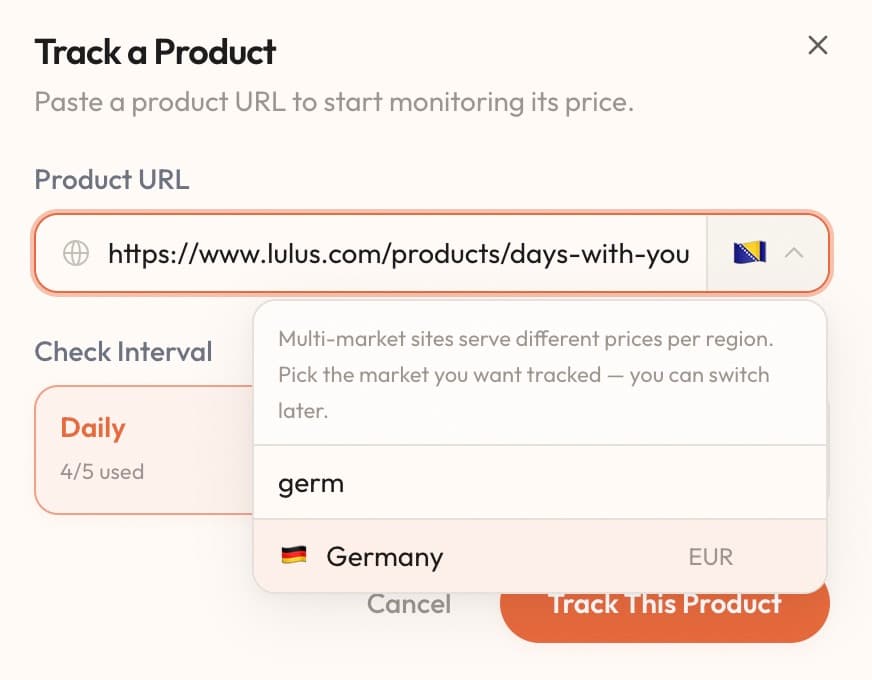
dipd pre-fills the sensible default: if the URL itself names a market (many stores embed it in the path), that wins; otherwise your own country does. You can override either with two clicks, and pin the regions you use often to the top of the list. As the picker itself says: multi-market sites serve different prices per region, so pick the market you want tracked. You can switch later.
Switch markets any time
"Switch later" is a real feature, not a promise. On any product from a store where we've verified region switching, the tracked market sits right next to the price:
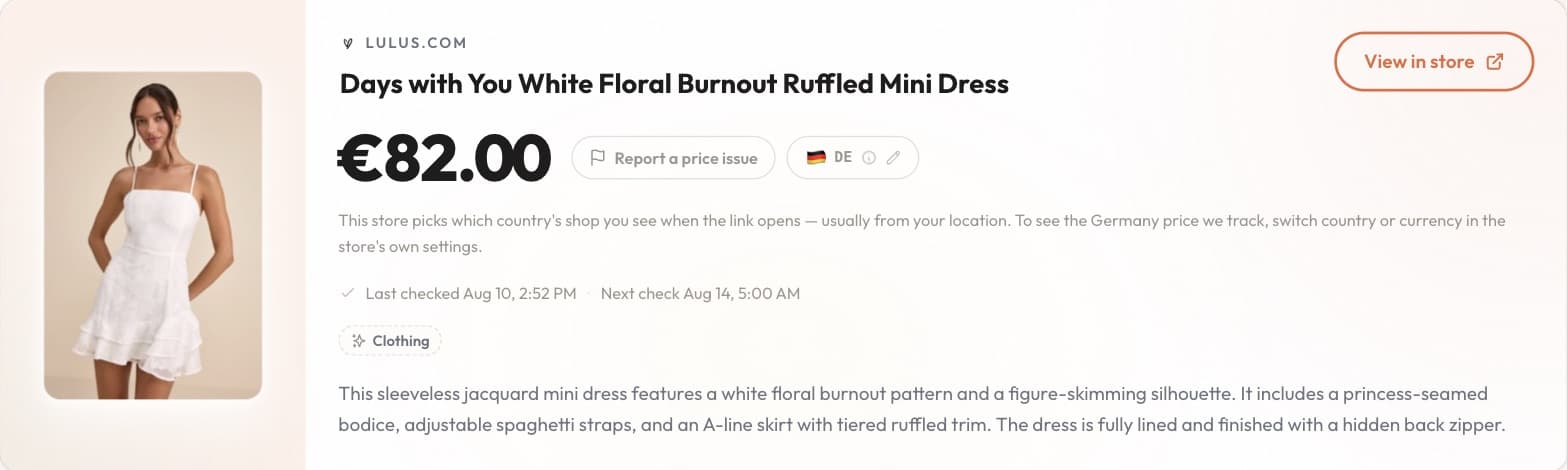
Click the pill and pick a new country. dipd immediately runs a fresh price check with that market's store settings applied, rather than waiting for the next scheduled check:
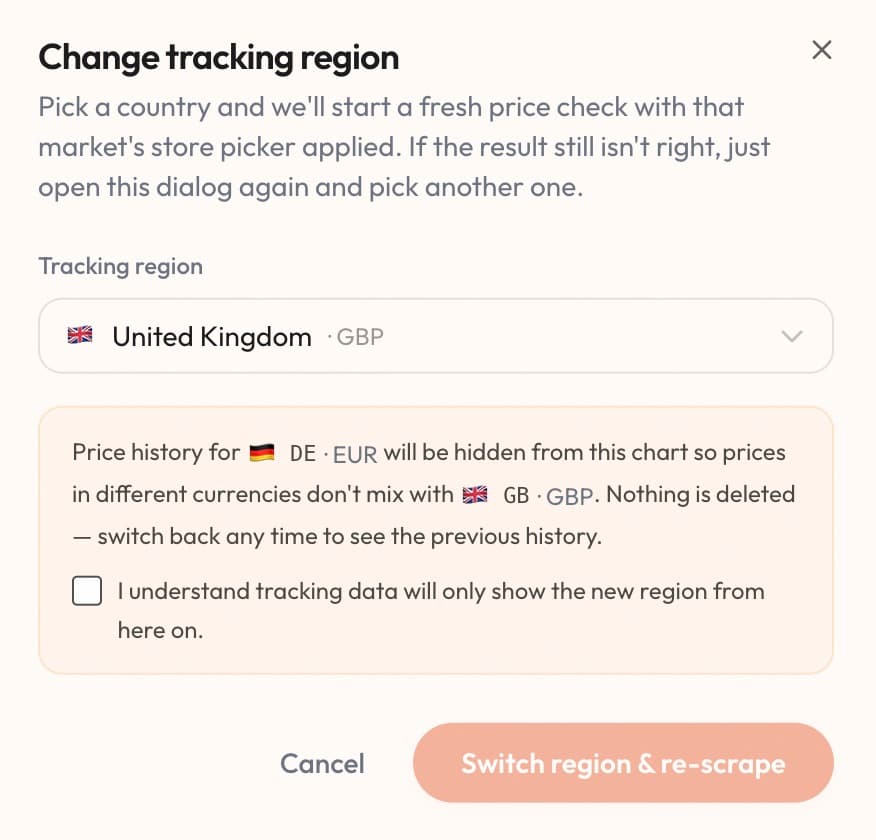
The notice in that dialog is worth reading closely, because it's where most trackers get sloppy. When you switch from EUR to GBP, dipd hides the old currency's history from the chart, because mixing currencies on one axis is how you fabricate price drops. But nothing is deleted: switch back and the previous history is right where you left it. And if you pick a market where the store simply doesn't sell the product, a one-click button offers to switch you back to the last market that worked.
The honest small print
Two more details, because geo pricing is full of edge cases and we'd rather disclose them than pretend they don't exist:
- Some stores don't sell in every local currency. Pick a market and the store may still price it in dollars or euros. When that happens, dipd shows a small ⓘ next to the price explaining the mismatch: the tracking is still correct, the store just doesn't run a price book in that currency.
- Some stores decide the market when you open the link. On stores that pick the country from your location, a link can't carry "show the German shop" with it. dipd tells you exactly that on the product page, and when you click through, how to flip the store's own country picker to see the price we track.
And if you'd rather just see everything in one currency: there's a display setting that converts all your tracked prices to your preferred currency at live rates, with the original amount kept alongside. Display only: the charts stay in each product's own currency, where the truth lives.
Any store, and more every week
dipd tracks products on any store, and region handling is verified store by store. Where we've proven a store's market switching works, the flag pill shows up and everything above just works. Where we haven't yet, the product still tracks fine in its default market.
dipd is evolving constantly, and stores get their geo pricing support enabled all the time. And honestly, knowing which store to look at next is half the work. If a store you track shows the wrong market or is missing the region pill, that's exactly what Report a price issue (right next to any price) and Send feedback (in the avatar menu) are for. We read everything.
We've done this exercise before with IKEA's per-country prices and America's largest retailers, and the conclusion keeps being the same. A store page tells you today's number for whoever the store thinks you are. A pinned market and a price history tell you what your price has been doing, and when it actually dips.